
If you’re planning a house extension in Dorset, one of the first questions is usually: do I need planning permission? The answer depends on the size and type of the extension, the rules in your area and whether your home falls inside a conservation area, AONB or is listed. The good news is that many extensions in Dorset can be built under permitted development rights without a full planning application — but the limits are specific and getting them wrong is expensive.
This 2026 guide explains, in plain English, when you do and don’t need planning permission for an extension in Dorset, and how to navigate the process if you do.
Permitted Development Rights in Dorset
Permitted development (PD) rights let homeowners make certain changes without applying for full planning permission. They were extended in 2019 and the larger home extension scheme is still in place in 2026. PD rules apply to most houses but not flats, maisonettes or listed buildings, and they’re tighter inside designated areas like the Dorset AONB or conservation areas.
Single-Storey Rear Extensions
- Detached houses: up to 8 m deep from the original rear wall
- Semi-detached and terraced houses: up to 6 m deep
- Maximum height of 4 m for a pitched roof, 3 m for a flat roof
- Eaves no higher than 3 m within 2 m of a boundary
Anything between 4 m and 8 m (or 3 m and 6 m) is allowed only under the Larger Home Extension prior approval scheme, which still requires a notice to Dorset Council and a 21-day neighbour consultation.
Two-Storey Rear Extensions
- Maximum 3 m deep from the original rear wall
- At least 7 m from the rear boundary
- Roof pitch must broadly match the existing house
- Side-facing first floor windows must be obscure-glazed and non-opening below 1.7 m
When You DO Need Planning Permission
You’ll usually need to submit a full planning application to Dorset Council if your project is in any of the following situations:
- The extension is larger than the PD limits above
- The property is a flat, maisonette or other building (not a single dwelling house)
- You live in a conservation area (e.g. Dorchester, Bridport, Sherborne, Lyme Regis)
- The home is in the Dorset AONB or another designated area
- The property is listed — listed building consent is also required
- Permitted development rights have been removed by an Article 4 direction
- You’re cladding the house in a designated area
Conservation Areas and AONB
Dorset has more than 60 conservation areas and a large stretch of the Dorset National Landscape (formerly AONB). If you live in one of these areas, expect tighter rules on materials, cladding, roof additions and side extensions. Stone, render and traditional clay tiles are usually preferred over modern materials.
The Dorset Planning Application Process
Step 1 — Pre-Application Advice
Dorset Council offers a pre-application advice service from around £150 for a householder enquiry. It’s optional but useful for ambitious schemes — you’ll get a written response from a planning officer that highlights likely concerns before you spend money on full drawings.
Step 2 — Drawings and Documentation
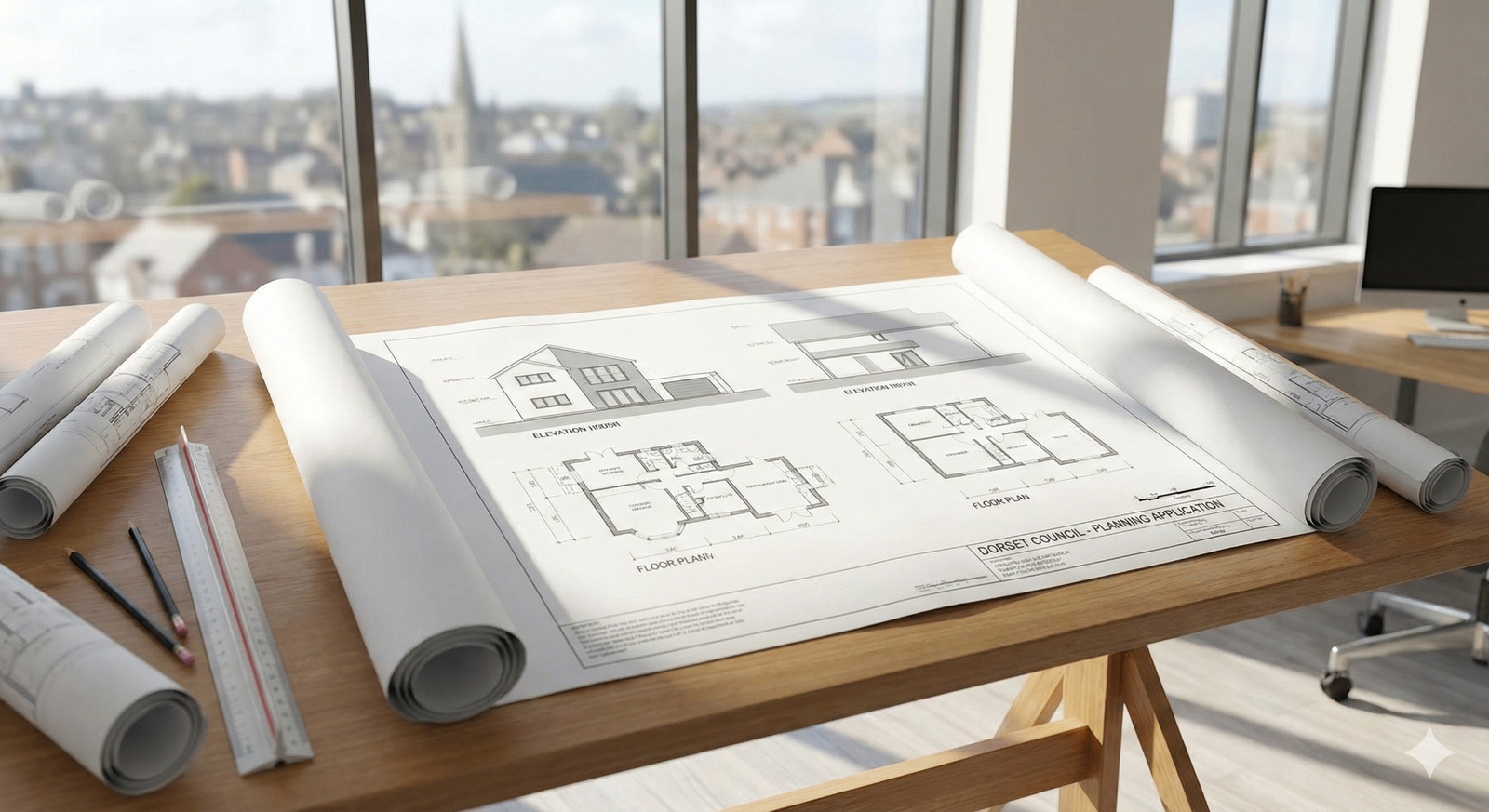
You’ll need accurate existing and proposed plans, elevations, a site location plan, a block plan and a Design & Access statement for some sites. Working with an architect or architectural designer is strongly recommended — local Dorset designers know what the council typically approves.
Step 3 — Submit and Pay
Householder application fees in 2026 are £368 (doubled from £206 in April 2025). Listed building consent is also £368, or £736 if you submit both together. All applications go through the Planning Portal.
Step 4 — Validation and Consultation
Once validated (usually within 5 working days) the application enters a 21-day consultation. Neighbours and statutory consultees can comment. A planning officer will visit and assess the application against local plan policies.
Step 5 — Decision
Most householder applications are decided within 8 weeks. Outcomes are: approved, approved with conditions, or refused. Refusals can be appealed to the Planning Inspectorate, but it’s usually quicker and cheaper to amend and resubmit.
Common Mistakes That Trigger Refusals in Dorset
- Overlooking neighbouring properties (consider obscure glazing or repositioning windows)
- Using materials that clash with the local vernacular — stone, render, slate, clay tile are usually safest
- Underestimating the impact on conservation area character
- Missing or low-quality drawings
- Insufficient parking provision
Building Regulations Are Separate
Even when planning permission isn’t required, virtually every extension needs building regulations approval. This covers structure, insulation, fire safety, drainage, ventilation and Part L energy performance. Dorset Building Control or an approved inspector can sign off the works in stages.
How KAP Woodwork & Building Services Can Help
We’ve delivered house extensions across Dorchester, Weymouth, Bridport, Sherborne and the wider Dorset area for more than 30 years. We work alongside trusted local architects to make sure your scheme stands the best chance of approval first time, then deliver the build to a high standard.
Whether you’re considering a kitchen extension, a side return, a two-storey rear extension or a complete renovation, we offer a free, no-obligation consultation. Get in touch today to discuss your project.
Related reading: House Extension Costs Dorset 2026 · House Extension Timeline · Our Extensions Service